Today I'd like to discuss Music Theory and how it applies to the aspiring guitarist in 2014 lol. I aim to write this post as an assessment of the importance and undeniable occurrence of theory. I will throughout this blog; attempt to create a tangible resource of theory for guitar. There is an entire spectrum of guitarists, ranging from anywhere throughout an un-quantifiable mix of traits. A few of which are ability, knowledge, fashion and style.
Some of you are gearheads, technique-o-philes, aural perfectionists and sloppy jammers. Some of you like and know theory, some simply know it and some avoid it at all costs. Whether you apply theory or not, theory applies to you.
What is Music Theory?
If you search Google for 'what is music theory' you are presented with the wikipedia definition.

It goes on to say...

Now I know that Wikipedia isn't the last word on any of the issues it covers but what it does show is our latest collective effort to define music theory across the platform and is extremely accessible for all.
If you delve a little further, you'll find that searching for 'what is music theory on guitar' will result in this...
There are definitely a lot of places to learn parts of theory. They come in a range of lists of technical advice, explanations of an assortment of places to put your fingers and groups of selected people who prove the existence of music theory with examples of its application.
If this is the human endeavor into understanding and developing music, I see a lack of an attempt to create a critical language which defines the processes by which its application to the guitar is experienced by the learner. I feel this is a critical part of learning an instrument.
This post is an attempt to explain what I would like to refer to as Meta-Music Theory.
The real hypocrisy is that I can only use technical advice, explanations of an assortment of places to put your fingers and groups of selected people who prove the existence of music theory with examples of its application within an ensemble of other musicians. I can resolve this by understanding that interaction with material explaining these things are part of a communal fabric interwoven in MMT.
In 2014, I think this aspect of experiencing the guitar is much ignored, unheard of, its discussion is resisted as if it's an offense. If I ask you what music theory is, can you answer with anything other than an example of its existence?
Another question to ask yourself is: in what ways, other than your ability to sit with a guitar, are you a guitarist. Are there any other ways?' Unlike many of the listeners, you can most likely discern rock ensemble instruments from each other even when they're playing together. That is not a trait held by an untrained ear. When mixed with the right kind of training and understanding, a musician's instrument becomes a platform for the interpretation and retextualising of sounds within specific relativistic interval distances.
There is the argument that these different systems of the music theory are semi rigid rules or guidelines. The fundamental idea that they provide a structured guide to the which notes have a canonical reputation for suitability. I think this is the most basic understanding of what music theory actually is.
What exactly are the 'permitted' notes suitable for? This is where the theory gets murky. In learning music theory, intervals play a key role in the defining of the function of permitted sounds. As you learn the notes in a scale, you should also learn their number which corresponds to their position and function in the scale.
In the learner arises a seemingly homeostatic relationships with the governing rules outlining the modes of a structured creation of binary opposition between precedence and disruption.
Dichotomies are established of contrasting qualities such as consonance and dissonance, loud and quiet, hard and soft.
This seems to be a formalist's way of utilizing theory:
A dynamic system of precedent setting and disruption.
Sometimes, I think of this push-pull relationship as more of a dialogue between myself and the theory. The interdependence of each dynamic relationship such as silence and noise, consonant and dissonant, rhythmic and arrhythmic reinforce themselves in order to increase the excitement and impact of the disrupting other.
These are the systems music theory teaches you to work with.
Your dealings with these transactions are the Meta-Theory. Your playing is an exposition of these transactions and the manipulation of your playing to suit the context of your music, whether purposeful or not, is the new virtuosity. Some people call it 'feel' or 'musicality'; its perceived effect is one of the things frequently projected back onto the musician as genius or an x-factor.
Tools of the Trade
As any good guide to the context for which the theory of an emergent context of music and its application to a specific instrument should, I will list a few of the commonly taught bits of music theory as applied to guitar in the early 21st Century.
A few other aspects of playing guitar are: -
You start out by holding a piece of wood. It feels kind of weird and almost out of this world but you really like the sounds other people have made with similar pieces and thought you'd have a try. You may seek out lessons from another person that plays or you may use another method in order to teach yourself.
The ends of your fingers will hurt and it's going to sound awkward for quite a while but this piece of wood will give you back in progress and accomplishment at a decent effort to outcome ratio. It has a nonlinear difficulty curve and progression system with many options and styles to specialise in.
Oh, And... you should know this too... we've developed an unfathomably large range of styles of playing, a multitude of different techniques and approaches to make almost any sound a possibility, an audience with widely varying taste and no set in stone definitive right way to do or even interpret guitar playing.
Be especially aware of your own blind spots. You will meet guitarists who are invested in genres or techniques or styles that they're almost typecast into roles. It's fine if you want to specialise but don't let a process of normalisation spoil or hinder the development of a wider pool from which you can derive influence and perceive.
Expose yourself to as much music as you can.
Some of you are gearheads, technique-o-philes, aural perfectionists and sloppy jammers. Some of you like and know theory, some simply know it and some avoid it at all costs. Whether you apply theory or not, theory applies to you.
What is Music Theory?
If you search Google for 'what is music theory' you are presented with the wikipedia definition.
It goes on to say...
Now I know that Wikipedia isn't the last word on any of the issues it covers but what it does show is our latest collective effort to define music theory across the platform and is extremely accessible for all.
If you delve a little further, you'll find that searching for 'what is music theory on guitar' will result in this...
 |
| It's the equivalent of asking what is food and being shown a sandwich |
There are definitely a lot of places to learn parts of theory. They come in a range of lists of technical advice, explanations of an assortment of places to put your fingers and groups of selected people who prove the existence of music theory with examples of its application.
If this is the human endeavor into understanding and developing music, I see a lack of an attempt to create a critical language which defines the processes by which its application to the guitar is experienced by the learner. I feel this is a critical part of learning an instrument.
This post is an attempt to explain what I would like to refer to as Meta-Music Theory.
The real hypocrisy is that I can only use technical advice, explanations of an assortment of places to put your fingers and groups of selected people who prove the existence of music theory with examples of its application within an ensemble of other musicians. I can resolve this by understanding that interaction with material explaining these things are part of a communal fabric interwoven in MMT.
In 2014, I think this aspect of experiencing the guitar is much ignored, unheard of, its discussion is resisted as if it's an offense. If I ask you what music theory is, can you answer with anything other than an example of its existence?
Another question to ask yourself is: in what ways, other than your ability to sit with a guitar, are you a guitarist. Are there any other ways?' Unlike many of the listeners, you can most likely discern rock ensemble instruments from each other even when they're playing together. That is not a trait held by an untrained ear. When mixed with the right kind of training and understanding, a musician's instrument becomes a platform for the interpretation and retextualising of sounds within specific relativistic interval distances.
There is the argument that these different systems of the music theory are semi rigid rules or guidelines. The fundamental idea that they provide a structured guide to the which notes have a canonical reputation for suitability. I think this is the most basic understanding of what music theory actually is.
What exactly are the 'permitted' notes suitable for? This is where the theory gets murky. In learning music theory, intervals play a key role in the defining of the function of permitted sounds. As you learn the notes in a scale, you should also learn their number which corresponds to their position and function in the scale.
In the learner arises a seemingly homeostatic relationships with the governing rules outlining the modes of a structured creation of binary opposition between precedence and disruption.
Dichotomies are established of contrasting qualities such as consonance and dissonance, loud and quiet, hard and soft.
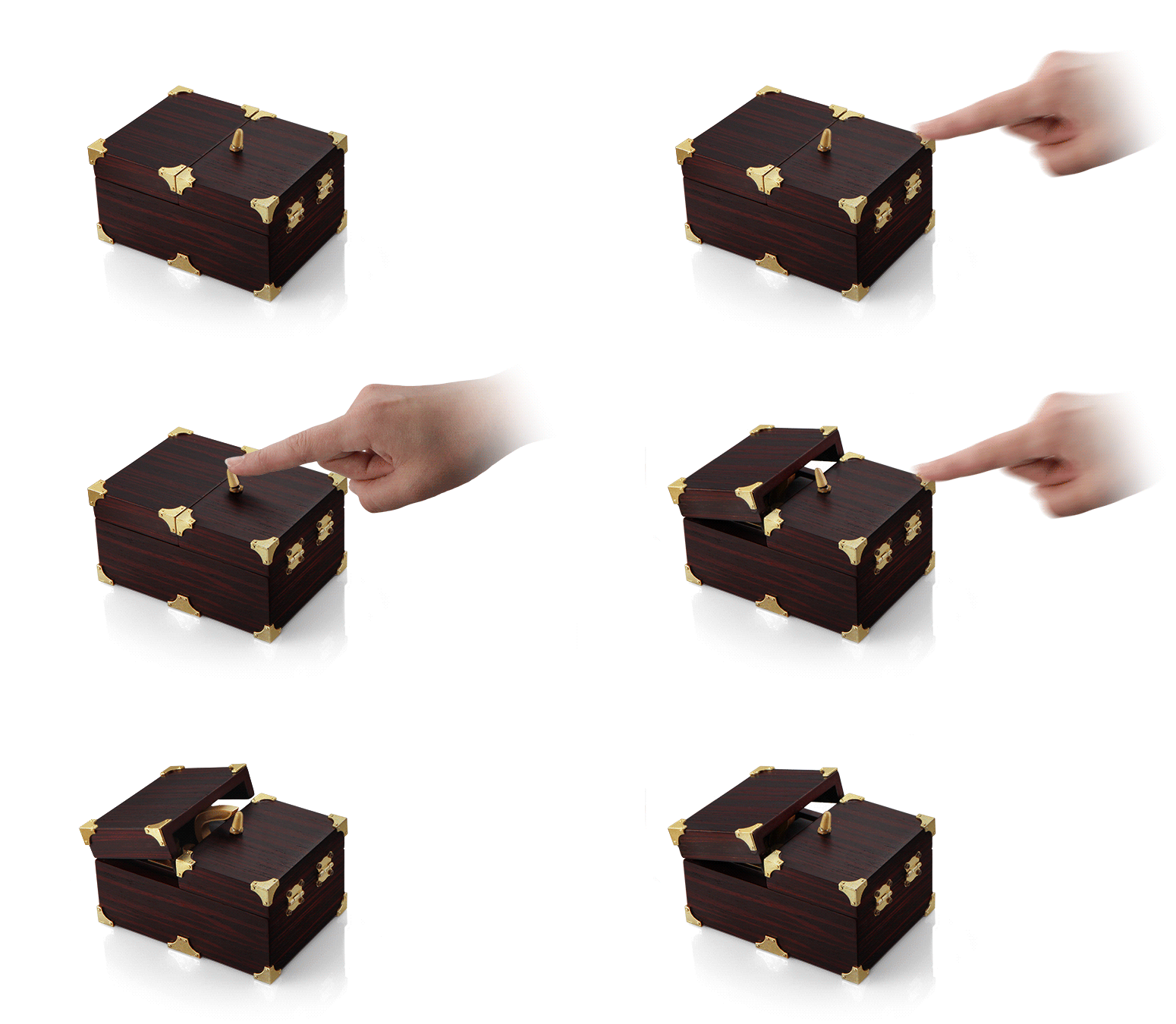
This seems to be a formalist's way of utilizing theory:
A dynamic system of precedent setting and disruption.
 |
These are the systems music theory teaches you to work with.
Your dealings with these transactions are the Meta-Theory. Your playing is an exposition of these transactions and the manipulation of your playing to suit the context of your music, whether purposeful or not, is the new virtuosity. Some people call it 'feel' or 'musicality'; its perceived effect is one of the things frequently projected back onto the musician as genius or an x-factor.
Tools of the Trade
As any good guide to the context for which the theory of an emergent context of music and its application to a specific instrument should, I will list a few of the commonly taught bits of music theory as applied to guitar in the early 21st Century.
- Where to place your fingers to play a chord or melody
- Specific pools of notes known as scales
- Where these notes appear on your instrument
- How to build chords from scales
- How common scales and modes apply to each other
- How to read tab
- Chord progressions
A few other aspects of playing guitar are: -
- Your 'technique'
- Your 'ear'
You start out by holding a piece of wood. It feels kind of weird and almost out of this world but you really like the sounds other people have made with similar pieces and thought you'd have a try. You may seek out lessons from another person that plays or you may use another method in order to teach yourself.
The ends of your fingers will hurt and it's going to sound awkward for quite a while but this piece of wood will give you back in progress and accomplishment at a decent effort to outcome ratio. It has a nonlinear difficulty curve and progression system with many options and styles to specialise in.
Oh, And... you should know this too... we've developed an unfathomably large range of styles of playing, a multitude of different techniques and approaches to make almost any sound a possibility, an audience with widely varying taste and no set in stone definitive right way to do or even interpret guitar playing.
Be especially aware of your own blind spots. You will meet guitarists who are invested in genres or techniques or styles that they're almost typecast into roles. It's fine if you want to specialise but don't let a process of normalisation spoil or hinder the development of a wider pool from which you can derive influence and perceive.
Expose yourself to as much music as you can.

No comments:
Post a Comment